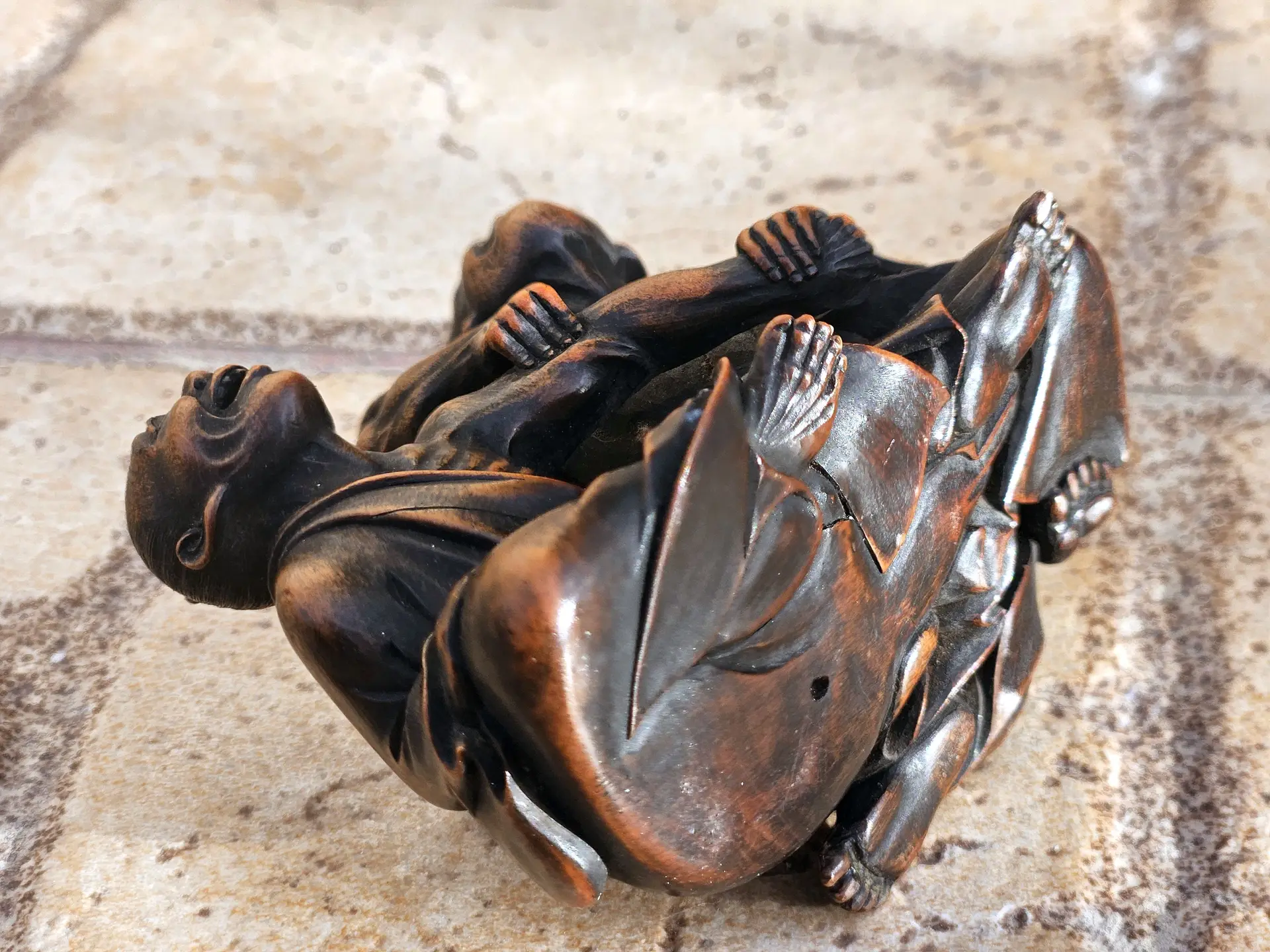
An exceptional and animated Meiji-period Japanese okimono carved from richly patinated boxwood, depicting a traditional blind anma (按摩 – masseur) performing a therapeutic arm massage on a seated client. The scene captures a moment of lively interaction, blending realism with humor and empathy — hallmarks of fine Japanese craftsmanship.
The blind masseur, distinguished by his inlaid opaque eyes and intense facial expression, grips the other man’s arm in a strong therapeutic hold. His mouth is slightly agape, as if breathing or concentrating through the effort. The masseur’s posture leans forward in active engagement, reinforcing his tactile reliance due to blindness — a detail culturally accurate for the profession in Japan, where massage was one of the few accepted trades for the blind since the Edo period.
The client, seated cross-legged and partially undressed, shows exaggerated ribs and a joyful expression, suggesting a mix of ticklishness and relief as he reacts to the pressure. His head is thrown slightly back, mouth open in laughter, eyes expressive — possibly suggesting pain-pleasure, a common visual trope in such depictions.
Both figures wear simple robes with beautifully carved folds and textures. The okimono displays high technical skill in the rendering of muscle definition, hand tension, and naturalistic drapery. The interplay between the two figures conveys not only a physical scene but a human relationship — a miniature drama frozen in wood.
Period: Meiji era (circa 1880–1912)
Material: Stained boxwood with inlaid eyes (likely bone )
Origin: Japan
Height: 10 cm